Pdf Demo Juniper JN0-683 Download & Latest JN0-683 Test Blueprint
Wiki Article
BONUS!!! Download part of BraindumpsIT JN0-683 dumps for free: https://drive.google.com/open?id=1PxO-Dhn4iDxms6VdaEv32-bYMwIk9Tx9
The passing rate of our JN0-683 test torrent is high but if you fail in the exam we will refund you in full immediately. Some people may worry that the refund procedure is complicate but we guarantee to the client that the refund procedure is very simple. If only you provide the screenshot or the scanning copy of JN0-683 Exam failure marks list we will refund you immediately and the process is really simple. It is very worthy for you to buy our JN0-683 guide questions and we can help you pass the exam successfully.
Juniper JN0-683 Exam Syllabus Topics:
| Topic | Details |
|---|---|
| Topic 1 |
|
| Topic 2 |
|
| Topic 3 |
|
| Topic 4 |
|
>> Pdf Demo Juniper JN0-683 Download <<
Free PDF 2026 Juniper JN0-683: Marvelous Pdf Demo Data Center, Professional (JNCIP-DC) Download
The social environment is constantly changing, and our JN0-683 guide quiz is also advancing with the times. We have all kinds of experiences on the JN0-683 study braindumps for many years, so we know that the content of the exam is related to real-time information. The content of JN0-683 Exam Materials is constantly updated. Our professional experts have been specilizing in this career for over ten years. And we can always provide with you the most accurate and valid JN0-683 learning guide.
Juniper Data Center, Professional (JNCIP-DC) Sample Questions (Q43-Q48):
NEW QUESTION # 43
You are designing an IP fabricfora large data center, and you are concerned about growth and scalability.
Which two actions would you take to address these concerns? (Choose two.)
- A. Design a three-stage Clos IP fabric.
- B. Design a five-stage Clos IP fabric.
- C. Use EX4300 Series devices as the spine devices.
- D. Use OFX5700 Series devices as the super spines.
Answer: B,D
NEW QUESTION # 44
Exhibit.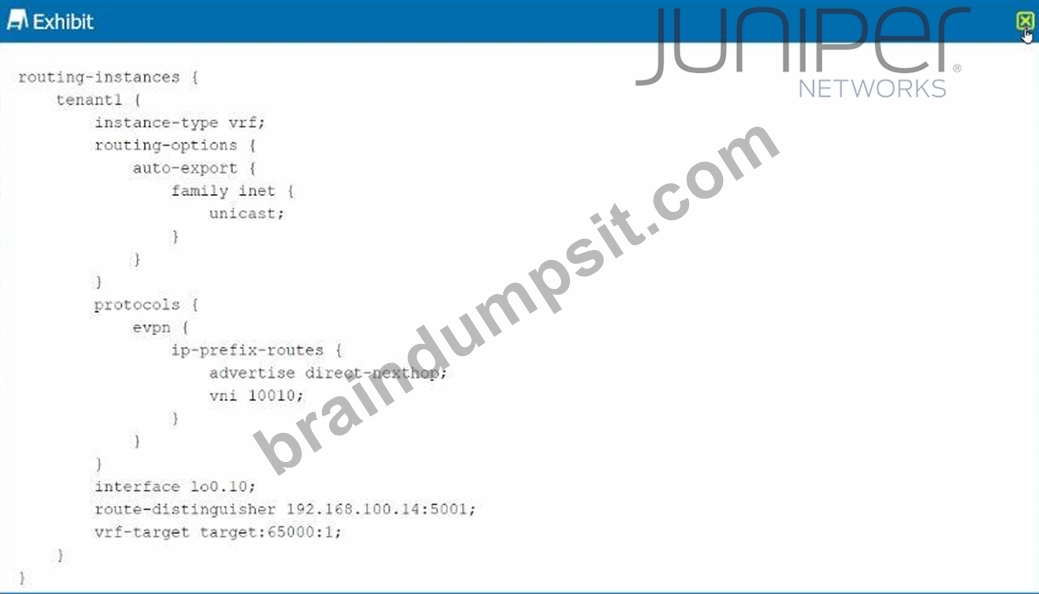
You want to enable the border leaf device to send Type 5 routes of local networks to the border leaf device in another data center. What must be changed to the configuration shown in the exhibit to satisfy this requirement?
- A. Add encapsulation vxlan to the evpn hierarchy.
- B. Move vrf-target target: 65000:1 to the evpn hierarchy.
- C. Change: 5001 in the route-distinguisher to : 10010.
- D. Add a VLAN configuration with an 13-interface to the tenant1 routing instance.
Answer: B
Explanation:
In this scenario, you want the border leaf device to advertise Type 5 EVPN routes to another border leaf in a different data center. Type 5 routes in EVPN are used to advertise IP prefixes, which means that for proper route advertisement, you need to configure the correct settings within the evpn hierarchy.
Step-by-Step Analysis:
* Understanding EVPN Type 5 Routes:
* EVPN Type 5 routes are used to advertise IP prefixes across EVPN instances, which allow different data centers or networks to exchange routing information effectively.
* VRF Target Setting:
* The vrf-target configuration is crucial because it defines the export and import policies for the VRF within the EVPN instance. For EVPN Type 5 routes to be advertised to other border leaf devices, the vrf-target needs to be correctly configured under the evpn hierarchy, not just within the routing instance.
Command to solve this:
move vrf-target target:65000:1 to evpn
* Other Options:
* Option B:Adding a VLAN configuration would not address the requirement to advertise Type 5 routes.
* Option C:Adding VXLAN encapsulation may be necessary for other scenarios but does not directly address the Type 5 route advertisement.
* Option D:Changing the route-distinguisher will differentiate routes but does not impact the advertisement of Type 5 routes to other data centers.
By moving the vrf-target to the evpn hierarchy, you enable the proper route advertisement, ensuring that the Type 5 routes for local networks are shared with other data center border leaf devices. This is aligned with best practices for multi-data center EVPN implementations, which emphasize the correct placement of routing policies within the EVPN configuration.
NEW QUESTION # 45
You are deploying a new network to support your AI workloads on devices that support at least
400 Gbps Ethernet. There is no requirement for any Layer 2 VLANs in this network.
Which network architecture would satisfy this requirement?
- A. an IP fabric using EBGP
- B. an IP fabric using PIM-SM to signal VXLAN overlay
- C. an IP fabric with an EVPN-VXLAN architecture
- D. an IP fabric using the EVPN-MPLS architecture
Answer: A
Explanation:
For high-performance AI workloads requiring speeds of 400 Gbps or more, a pure Layer 3 IP fabric using EBGP underlay routing is typically deployed for scalability and efficiency. This avoids the complexities of Layer 2 VLANs and minimizes oversubscription.
EBGP-based IP fabrics are common in modern data centers to provide large-scale, scalable, and high-bandwidth connectivity between leaves and spines with VXLAN or other overlays as appropriate but without mandatory Layer 2 VLANs.
EBGP-based IP fabrics typically provide a pure Layer 3 routing underlay that scales easily with high port speeds such as 400Gbps.
NEW QUESTION # 46
You manage an IP fabric with an EVPN-VXLAN overlay. You have multiple tenants separated using multiple unique VRF instances. You want to determine the routing information that belongs in each routing instance's routing table.
In this scenario, which property is used for this purpose?
- A. the route distinguisher value
- B. the VRF table label
- C. the VRF target community
- D. the routing instance type
Answer: A
Explanation:
In an EVPN-VXLAN overlay, the route distinguisher (RD) is used to uniquely identify routes in different VRFs (Virtual Routing and Forwarding instances). The RD allows the same IP address to be used in different VRFs, making sure the routing information for each tenant is separated.
The RD value ensures that each routing instance (or VRF) has its own unique address space and routing table entries.
NEW QUESTION # 47
You are asked to interconnect two data centers using a method that provides EVPN Type 2 connectivity, is highly scalable, and limits VXLAN tunnels between border leaf devices.
What will satisfy these requirements?
- A. EVPN Type 2 stretch
- B. IP VPN
- C. over the top full-mesh interconnect
- D. Type 2 seamless stitching
Answer: D
Explanation:
Type 2 seamless stitching is the best solution for interconnecting two data centers while providing EVPN Type 2 connectivity (MAC/IP routes for end-host reachability), high scalability, and limiting VXLAN tunnels between border leaf devices. This method ensures that MAC addresses are properly learned and distributed across the two data centers without requiring a full mesh of VXLAN tunnels between all leaf switches. Instead, VXLAN tunnels are limited to border leaf devices, reducing the complexity and improving scalability.
NEW QUESTION # 48
......
The JN0-683 web-based practice exam requires no installation so you can start your preparation instantly right after you purchase. With thousands of satisfied customers around the globe, questions of the Data Center, Professional (JNCIP-DC) (JN0-683) exam dumps are real so you can pass the Juniper JN0-683 certification on the very first attempt. Hence, it reduces your chances of failure and you can save money and time as well.
Latest JN0-683 Test Blueprint: https://www.braindumpsit.com/JN0-683_real-exam.html
- Use Real Juniper JN0-683Exam Dumps 2026 100% Guaranteed Success ???? Search on ▛ www.practicevce.com ▟ for ➽ JN0-683 ???? to obtain exam materials for free download ⛰JN0-683 New Dumps Files
- 100% Pass 2026 High-quality JN0-683: Pdf Demo Data Center, Professional (JNCIP-DC) Download ???? The page for free download of ➡ JN0-683 ️⬅️ on { www.pdfvce.com } will open immediately ????JN0-683 Test Dump
- Valid JN0-683 Test Questions ???? Exam JN0-683 Preview ???? JN0-683 Real Braindumps ☔ Open website 【 www.exam4labs.com 】 and search for ⮆ JN0-683 ⮄ for free download ????Latest JN0-683 Test Guide
- JN0-683 Test Dump ???? JN0-683 Brain Dumps ???? JN0-683 Brain Dumps ???? Open ▶ www.pdfvce.com ◀ and search for ✔ JN0-683 ️✔️ to download exam materials for free ????JN0-683 Exam Questions Fee
- 100% Pass Quiz JN0-683 - Accurate Pdf Demo Data Center, Professional (JNCIP-DC) Download ???? Open 【 www.vce4dumps.com 】 enter [ JN0-683 ] and obtain a free download ♥Exam JN0-683 Topic
- A Field Guide to JN0-683 All-in-One Exam Guide ???? Open website 《 www.pdfvce.com 》 and search for 《 JN0-683 》 for free download ????JN0-683 Materials
- 100% Pass 2026 Juniper Perfect JN0-683: Pdf Demo Data Center, Professional (JNCIP-DC) Download ???? Search for “ JN0-683 ” and download it for free immediately on ✔ www.examcollectionpass.com ️✔️ ????JN0-683 Test Dump
- JN0-683 Materials ???? JN0-683 Latest Dumps Pdf ✅ Latest JN0-683 Version ???? Search for 【 JN0-683 】 and download it for free on { www.pdfvce.com } website ????JN0-683 Brain Dumps
- Use Real Juniper JN0-683Exam Dumps 2026 100% Guaranteed Success ???? Search for ⮆ JN0-683 ⮄ and easily obtain a free download on ➽ www.vce4dumps.com ???? ⛪JN0-683 Valid Test Test
- No Internet? No Problem! Prepare For Juniper JN0-683 Exam Offline ???? Search for { JN0-683 } and download it for free immediately on ▛ www.pdfvce.com ▟ ????JN0-683 Materials
- A Field Guide to JN0-683 All-in-One Exam Guide ???? Search for ✔ JN0-683 ️✔️ and download it for free on ▶ www.practicevce.com ◀ website ????JN0-683 Authentic Exam Questions
- zaynpodx602421.dailyblogzz.com, safiyakcch396280.wikiconverse.com, tinybookmarks.com, bookmarkalexa.com, nicolevmbp185581.loginblogin.com, cecilyxmuh082192.yomoblog.com, emeralddirectory.com, preniumdirectory.com, top10bookmark.com, saadgydq996797.techionblog.com, Disposable vapes
2026 Latest BraindumpsIT JN0-683 PDF Dumps and JN0-683 Exam Engine Free Share: https://drive.google.com/open?id=1PxO-Dhn4iDxms6VdaEv32-bYMwIk9Tx9
Report this wiki page