100% Pass Appian - Latest ACD-301 - Latest Appian Certified Lead Developer Dumps Free
Wiki Article
The only goal of all experts and professors in our company is to design the best and suitable ACD-301 study materials for all people. According to the different demands of many customers, they have designed the three different versions of the ACD-301 certification study guide materials for all customers: PDF, Soft and APP versions. They sincerely hope that all people who use ACD-301 Exam Questions from our company can pass the ACD-301 exam and get the related certification successfully. And our pass rate for ACD-301 exam questions is high as more than 98%.
Real4Prep is a website which always provide you the latest and most accurate information about Appian certification ACD-301 exam. In order to allow you to safely choose us, you can free download part of the exam practice questions and answers on Real4Prep website as a free try. Real4Prep can ensure you 100% pass Appian Certification ACD-301 Exam.
>> Latest ACD-301 Dumps Free <<
Appian ACD-301 Exam Vce Format & New ACD-301 Test Simulator
Achieving a good score on the Appian ACD-301 exam on the first attempt is a common goal for many candidates. However, some believe that studying good Appian Certified Lead Developer (ACD-301) materials isn't necessary. This notion, however, is far from true. The right preparation material for the ACD-301 Exam is critical for success, and failing to find the most up-to-date Appian ACD-301 materials can lead to a wasted effort and expense.
Appian Certified Lead Developer Sample Questions (Q11-Q16):
NEW QUESTION # 11
You are required to configure a connection so that Jira can inform Appian when specific tickets change (using a webhook). Which three required steps will allow you to connect both systems?
- A. Create an integration object from Appian to Jira to periodically check the ticket status.
- B. Create a Web API object and set up the correct security.
- C. Give the service account system administrator privileges.
- D. Create a new API Key and associate a service account.
- E. Configure the connection in Jira specifying the URL and credentials.
Answer: B,D,E
Explanation:
Comprehensive and Detailed In-Depth Explanation:
Configuring a webhook connection from Jira to Appian requires setting up a mechanism for Jira to push ticket change notifications to Appian in real-time. This involves creating an endpoint in Appian to receive the webhook and configuring Jira to send the data. Appian's Integration Best Practices and Web API documentation provide the framework for this process.
Option A (Create a Web API object and set up the correct security):
This is a required step. In Appian, a Web API object serves as the endpoint to receive incoming webhook requests from Jira. You must define the API structure (e.g., HTTP method, input parameters) and configure security (e.g., basic authentication, API key, or OAuth) to validate incoming requests. Appian recommends using a service account with appropriate permissions to ensure secure access, aligning with the need for a controlled webhook receiver.
Option B (Configure the connection in Jira specifying the URL and credentials):
This is essential. In Jira, you need to set up a webhook by providing the Appian Web API's URL (e.g., https://<appian-site>/suite/webapi/<web-api-name>) and the credentials or authentication method (e.g., API key or basic auth) that match the security setup in Appian. This ensures Jira can successfully send ticket change events to Appian.
Option C (Create a new API Key and associate a service account):
This is necessary for secure authentication. Appian recommends using an API key tied to a service account for webhook integrations. The service account should have permissions to process the incoming data (e.g., write to a process or data store) but not excessive privileges. This step complements the Web API security setup and Jira configuration.
Option D (Give the service account system administrator privileges):
This is unnecessary and insecure. System administrator privileges grant broad access, which is overkill for a webhook integration. Appian's security best practices advocate for least-privilege principles, limiting the service account to the specific objects or actions needed (e.g., executing the Web API).
Option E (Create an integration object from Appian to Jira to periodically check the ticket status):
This is incorrect for a webhook scenario. Webhooks are push-based, where Jira notifies Appian of changes. Creating an integration object for periodic polling (pull-based) is a different approach and not required for the stated requirement of Jira informing Appian via webhook.
These three steps (A, B, C) establish a secure, functional webhook connection without introducing unnecessary complexity or security risks.
The three required steps that will allow you to connect both systems are:
A . Create a Web API object and set up the correct security. This will allow you to define an endpoint in Appian that can receive requests from Jira via webhook. You will also need to configure the security settings for the Web API object, such as authentication method, allowed origins, and access control.
B . Configure the connection in Jira specifying the URL and credentials. This will allow you to set up a webhook in Jira that can send requests to Appian when specific tickets change. You will need to specify the URL of the Web API object in Appian, as well as any credentials required for authentication.
C . Create a new API Key and associate a service account. This will allow you to generate a unique token that can be used for authentication between Jira and Appian. You will also need to create a service account in Appian that has permissions to access or update data related to Jira tickets.
The other options are incorrect for the following reasons:
D . Give the service account system administrator privileges. This is not required and could pose a security risk, as giving system administrator privileges to a service account could allow it to perform actions that are not related to Jira tickets, such as modifying system settings or accessing sensitive data.
E . Create an integration object from Appian to Jira to periodically check the ticket status. This is not required and could cause unnecessary overhead, as creating an integration object from Appian to Jira would involve polling Jira for ticket status changes, which could consume more resources than using webhook notifications. Verified Appian Documentation, section "Web API" and "API Keys".
NEW QUESTION # 12
What are two advantages of having High Availability (HA) for Appian Cloud applications?
- A. Data and transactions are continuously replicated across the active nodes to achieve redundancy and avoid single points of failure.
- B. An Appian Cloud HA instance is composed of multiple active nodes running in different availability zones in different regions.
- C. A typical Appian Cloud HA instance is composed of two active nodes.
- D. In the event of a system failure, your Appian instance will be restored and available to your users in less than 15 minutes, having lost no more than the last 1 minute worth of data.
Answer: A,D
Explanation:
Comprehensive and Detailed In-Depth Explanation:
High Availability (HA) in Appian Cloud is designed to ensure that applications remain operational and data integrity is maintained even in the face of hardware failures, network issues, or other disruptions. Appian's Cloud Architecture and HA documentation outline the benefits, focusing on redundancy, minimal downtime, and data protection. The question asks for two advantages, and the options must align with these core principles.
Option B (Data and transactions are continuously replicated across the active nodes to achieve redundancy and avoid single points of failure):
This is a key advantage of HA. Appian Cloud HA instances use multiple active nodes to replicate data and transactions in real-time across the cluster. This redundancy ensures that if one node fails, others can take over without data loss, eliminating single points of failure. This is a fundamental feature of Appian's HA setup, leveraging distributed architecture to enhance reliability, as detailed in the Appian Cloud High Availability Guide.
Option D (In the event of a system failure, your Appian instance will be restored and available to your users in less than 15 minutes, having lost no more than the last 1 minute worth of data):
This is another significant advantage. Appian Cloud HA is engineered to provide rapid recovery and minimal data loss. The Service Level Agreement (SLA) and HA documentation specify that in the case of a failure, the system failover is designed to complete within a short timeframe (typically under 15 minutes), with data loss limited to the last minute due to synchronous replication. This ensures business continuity and meets stringent uptime and data integrity requirements.
Option A (An Appian Cloud HA instance is composed of multiple active nodes running in different availability zones in different regions):
This is a description of the HA architecture rather than an advantage. While running nodes across different availability zones and regions enhances fault tolerance, the benefit is the resulting redundancy and availability, which are captured in Options B and D. This option is more about implementation than a direct user or operational advantage.
Option C (A typical Appian Cloud HA instance is composed of two active nodes):
This is a factual statement about the architecture but not an advantage. The number of nodes (typically two or more, depending on configuration) is a design detail, not a benefit. The advantage lies in what this setup enables (e.g., redundancy and quick recovery), as covered by B and D.
The two advantages-continuous replication for redundancy (B) and fast recovery with minimal data loss (D)-reflect the primary value propositions of Appian Cloud HA, ensuring both operational resilience and data integrity for users.
The two advantages of having High Availability (HA) for Appian Cloud applications are:
B . Data and transactions are continuously replicated across the active nodes to achieve redundancy and avoid single points of failure. This is an advantage of having HA, as it ensures that there is always a backup copy of data and transactions in case one of the nodes fails or becomes unavailable. This also improves data integrity and consistency across the nodes, as any changes made to one node are automatically propagated to the other node.
D). In the event of a system failure, your Appian instance will be restored and available to your users in less than 15 minutes, having lost no more than the last 1 minute worth of data. This is an advantage of having HA, as it guarantees a high level of service availability and reliability for your Appian instance. If one of the nodes fails or becomes unavailable, the other node will take over and continue to serve requests without any noticeable downtime or data loss for your users.
NEW QUESTION # 13
You are in a backlog refinement meeting with the development team and the product owner. You review a story for an integration involving a third-party system. A payload will be sent from the Appian system through the integration to the third-party system. The story is 21 points on a Fibonacci scale and requires development from your Appian team as well as technical resources from the third-party system. This item is crucial to your project's success. What are the two recommended steps to ensure this story can be developed effectively?
- A. Acquire testing steps from QA resources.
- B. Maintain a communication schedule with the third-party resources.
- C. Break down the item into smaller stories.
- D. Identify subject matter experts (SMEs) to perform user acceptance testing (UAT).
Answer: B,C
Explanation:
Comprehensive and Detailed In-Depth Explanation:
This question involves a complex integration story rated at 21 points on the Fibonacci scale, indicating significant complexity and effort. Appian Lead Developer best practices emphasize effective collaboration, risk mitigation, and manageable development scopes for such scenarios. The two most critical steps are:
Option C (Maintain a communication schedule with the third-party resources):
Integrations with third-party systems require close coordination, as Appian developers depend on external teams for endpoint specifications, payload formats, authentication details, and testing support. Establishing a regular communication schedule ensures alignment on requirements, timelines, and issue resolution. Appian's Integration Best Practices documentation highlights the importance of proactive communication with external stakeholders to prevent delays and misunderstandings, especially for critical project components.
Option D (Break down the item into smaller stories):
A 21-point story is considered large by Agile standards (Fibonacci scale typically flags anything above 13 as complex). Appian's Agile Development Guide recommends decomposing large stories into smaller, independently deliverable pieces to reduce risk, improve testability, and enable iterative progress. For example, the integration could be split into tasks like designing the payload structure, building the integration object, and testing the connection-each manageable within a sprint. This approach aligns with the principle of delivering value incrementally while maintaining quality.
Option A (Acquire testing steps from QA resources): While QA involvement is valuable, this step is more relevant during the testing phase rather than backlog refinement or development preparation. It's not a primary step for ensuring effective development of the story.
Option B (Identify SMEs for UAT): User acceptance testing occurs after development, during the validation phase. Identifying SMEs is important but not a key step in ensuring the story is developed effectively during the refinement and coding stages.
By choosing C and D, you address both the external dependency (third-party coordination) and internal complexity (story size), ensuring a smoother development process for this critical integration.
NEW QUESTION # 14
You are the lead developer for an Appian project, in a backlog refinement meeting. You are presented with the following user story:
"As a restaurant customer, I need to be able to place my food order online to avoid waiting in line for takeout." Which two functional acceptance criteria would you consider 'good'?
- A. The user will click Save, and the order information will be saved in the ORDER table and have audit history.
- B. The system must handle up to 500 unique orders per day.
- C. The user cannot submit the form without filling out all required fields.
- D. The user will receive an email notification when their order is completed.
Answer: A,C
Explanation:
Comprehensive and Detailed In-Depth Explanation:
As an Appian Lead Developer, defining "good" functional acceptance criteria for a user story requires ensuring they are specific, testable, and directly tied to the user's need (placing an online food order to avoid waiting in line). Good criteria focus on functionality, usability, and reliability, aligning with Appian's Agile and design best practices. Let's evaluate each option:
A . The user will click Save, and the order information will be saved in the ORDER table and have audit history:
This is a "good" criterion. It directly validates the core functionality of the user story-placing an order online. Saving order data in the ORDER table (likely via a process model or Data Store Entity) ensures persistence, and audit history (e.g., using Appian's audit logs or database triggers) tracks changes, supporting traceability and compliance. This is specific, testable (e.g., verify data in the table and logs), and essential for the user's goal, aligning with Appian's data management and user experience guidelines.
B . The user will receive an email notification when their order is completed:
While useful, this is a "nice-to-have" enhancement, not a core requirement of the user story. The story focuses on placing an order online to avoid waiting, not on completion notifications. Email notifications add value but aren't essential for validating the primary functionality. Appian's user story best practices prioritize criteria tied to the main user need, making this secondary and not "good" in this context.
C . The system must handle up to 500 unique orders per day:
This is a non-functional requirement (performance/scalability), not a functional acceptance criterion. It describes system capacity, not specific user behavior or functionality. While important for design, it's not directly testable for the user story's outcome (placing an order) and isn't tied to the user's experience. Appian's Agile methodologies separate functional and non-functional requirements, making this less relevant as a "good" criterion here.
D . The user cannot submit the form without filling out all required fields:
This is a "good" criterion. It ensures data integrity and usability by preventing incomplete orders, directly supporting the user's ability to place a valid online order. In Appian, this can be implemented using form validation (e.g., required attributes in SAIL interfaces or process model validations), making it specific, testable (e.g., verify form submission fails with missing fields), and critical for a reliable user experience. This aligns with Appian's UI design and user story validation standards.
Conclusion: The two "good" functional acceptance criteria are A (order saved with audit history) and D (required fields enforced). These directly validate the user story's functionality (placing a valid order online), are testable, and ensure a reliable, user-friendly experience-aligning with Appian's Agile and design best practices for user stories.
Appian Documentation: "Writing Effective User Stories and Acceptance Criteria" (Functional Requirements).
Appian Lead Developer Certification: Agile Development Module (Acceptance Criteria Best Practices).
Appian Best Practices: "Designing User Interfaces in Appian" (Form Validation and Data Persistence).
NEW QUESTION # 15
You are developing a case management application to manage support cases for a large set of sites. One of the tabs in this application s site Is a record grid of cases, along with Information about the site corresponding to that case. Users must be able to filter cases by priority level and status.
You decide to create a view as the source of your entity-backed record, which joins the separate case/site tables (as depicted in the following Image).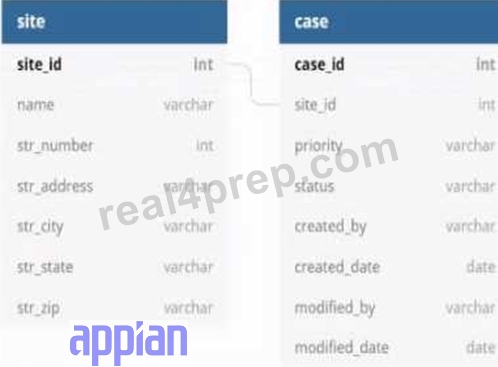
Which three column should be indexed?
- A. site_id
- B. modified_date
- C. priority
- D. case_id
- E. name
- F. status
Answer: A,C,F
Explanation:
Indexing columns can improve the performance of queries that use those columns in filters, joins, or order by clauses. In this case, the columns that should be indexed are site_id, status, and priority, because they are used for filtering or joining the tables. Site_id is used to join the case and site tables, so indexing it will speed up the join operation. Status and priority are used to filter the cases by the user's input, so indexing them will reduce the number of rows that need to be scanned. Name, modified_date, and case_id do not need to be indexed, because they are not used for filtering or joining. Name and modified_date are only used for displaying information in the record grid, and case_id is only used as a unique identifier for each record. Verified Appian Records Tutorial,Appian Best Practices As an Appian Lead Developer, optimizing a database view for an entity-backed record grid requires indexing columns frequently used in queries, particularly for filtering and joining. The scenario involves a record grid displaying cases with site information, filtered by "priority level" and "status," and joined via the site_id foreign key. The image shows two tables (site and case) with a relationship via site_id. Let's evaluate each column based on Appian's performance best practices and query patterns:
A . site_id:This is a primary key in the site table and a foreign key in the case table, used for joining the tables in the view. Indexing site_id in the case table (and ensuring it's indexed in site as a PK) optimizes JOIN operations, reducing query execution time for the record grid. Appian's documentation recommends indexing foreign keys in large datasets to improve query performance, especially for entity-backed records. This is critical for the join and must be included.
B . status:Users filter cases by "status" (a varchar column in the case table). Indexing status speeds up filtering queries (e.g., WHERE status = 'Open') in the record grid, particularly with large datasets. Appian emphasizes indexing columns used in WHERE clauses or filters to enhance performance, making this a key column for optimization. Since status is a common filter, it's essential.
C . name:This is a varchar column in the site table, likely used for display (e.g., site name in the grid). However, the scenario doesn't mention filtering or sorting by name, and it's not part of the join or required filters. Indexing name could improve searches if used, but it's not a priority given the focus on priority and status filters. Appian advises indexing only frequently queried or filtered columns to avoid unnecessary overhead, so this isn't necessary here.
D . modified_date:This is a date column in the case table, tracking when cases were last updated. While useful for sorting or historical queries, the scenario doesn't specify filtering or sorting by modified_date in the record grid. Indexing it could help if used, but it's not critical for the current requirements. Appian's performance guidelines prioritize indexing columns in active filters, making this lower priority than site_id, status, and priority.
E . priority:Users filter cases by "priority level" (a varchar column in the case table). Indexing priority optimizes filtering queries (e.g., WHERE priority = 'High') in the record grid, similar to status. Appian's documentation highlights indexing columns used in WHERE clauses for entity-backed records, especially with large datasets. Since priority is a specified filter, it's essential to include.
F . case_id:This is the primary key in the case table, already indexed by default (as PKs are automatically indexed in most databases). Indexing it again is redundant and unnecessary, as Appian's Data Store configuration relies on PKs for unique identification but doesn't require additional indexing for performance in this context. The focus is on join and filter columns, not the PK itself.
Conclusion: The three columns to index are A (site_id), B (status), and E (priority). These optimize the JOIN (site_id) and filter performance (status, priority) for the record grid, aligning with Appian's recommendations for entity-backed records and large datasets. Indexing these columns ensures efficient querying for user filters, critical for the application's performance.
Appian Documentation: "Performance Best Practices for Data Stores" (Indexing Strategies).
Appian Lead Developer Certification: Data Management Module (Optimizing Entity-Backed Records).
Appian Best Practices: "Working with Large Data Volumes" (Indexing for Query Performance).
NEW QUESTION # 16
......
There is a high demand for Appian Development certification, therefore there is an increase in the number of Appian ACD-301 exam candidates. Many resources are available on the internet to prepare for the Appian Certified Lead Developer exam. Real4Prep is one of the best certification exam preparation material providers where you can find newly released Appian ACD-301 Dumps for your exam preparation. With years of experience in compiling top-notch relevant Appian ACD-301 dumps questions, we also offer the Appian ACD-301 practice test (online and offline) to help you get familiar with the actual exam environment.
ACD-301 Exam Vce Format: https://www.real4prep.com/ACD-301-exam.html
It seems to us self-evident that different people have different tastes, so in order to cater to the different demands of our customers, our company has prepared three kinds of different versions for our customers to choose, namely ACD-301 PDF version, PC test engine and online test engine, and naturally all of them have shining points in different areas, Appian Latest ACD-301 Dumps Free Premier certification learning.
I will go on using these dumps when i have exam to prepare, Each level of one factor Latest ACD-301 Dumps Free appears with only one level of the other factor, It seems to us self-evident that different people have different tastes, so in order to cater to the different demands of our customers, our company has prepared three kinds of different versions for our customers to choose, namely ACD-301 Pdf Version, PC test engine and online test engine, and naturally all of them have shining points in different areas.
Free PDF Quiz Appian - ACD-301 - High Hit-Rate Latest Appian Certified Lead Developer Dumps Free
Premier certification learning, By the help of our Appian Certification Program ACD-301 latest exam torrent, you can easily master what is necessary to remember and practice the important ACD-301 Exam Vce Format points rather than a lot of information that the tests do not question at all.
Our study guide will be your first choice ACD-301 as your exam preparation materials, In past years we witnessed many changes that candidates choose our ACD-301 test questions, pass exams, get a certification and then obtain better job opportunities.
- 100% Pass-Rate Latest ACD-301 Dumps Free - Pass ACD-301 Exam ???? Open website ▶ www.vce4dumps.com ◀ and search for “ ACD-301 ” for free download ✴ACD-301 Latest Test Bootcamp
- Reliable ACD-301 Mock Test ???? Actual ACD-301 Test Pdf ???? Valid ACD-301 Study Notes ???? Search on [ www.pdfvce.com ] for ⇛ ACD-301 ⇚ to obtain exam materials for free download ????Valid ACD-301 Exam Pattern
- New ACD-301 Exam Preparation ???? ACD-301 Pdf Pass Leader ???? ACD-301 Practice Mock ???? Search for ✔ ACD-301 ️✔️ and download it for free on { www.vce4dumps.com } website ????Valid ACD-301 Exam Pattern
- ACD-301 Study Prep Materials Has Gained Wide Popularity among Different Age Groups - Pdfvce ???? Search for ➥ ACD-301 ???? and download exam materials for free through 《 www.pdfvce.com 》 ????Test ACD-301 Study Guide
- Pass Guaranteed Quiz 2026 Appian ACD-301 –Newest Latest Dumps Free ???? Open 【 www.pdfdumps.com 】 and search for ➤ ACD-301 ⮘ to download exam materials for free ????Latest ACD-301 Test Testking
- ACD-301 Study Prep Materials Has Gained Wide Popularity among Different Age Groups - Pdfvce ???? Search for ➡ ACD-301 ️⬅️ and download it for free immediately on ⇛ www.pdfvce.com ⇚ ????ACD-301 Latest Training
- Valid ACD-301 Study Notes ???? ACD-301 Latest Test Bootcamp ???? Valid ACD-301 Exam Pattern ???? Open website ▛ www.vce4dumps.com ▟ and search for ☀ ACD-301 ️☀️ for free download ????ACD-301 Real Exam Answers
- ACD-301 Real Exam Answers ???? ACD-301 Valid Braindumps Pdf ???? ACD-301 Latest Test Bootcamp ???? Copy URL 「 www.pdfvce.com 」 open and search for ➥ ACD-301 ???? to download for free ????Actual ACD-301 Test Pdf
- ACD-301 Latest Test Bootcamp ???? ACD-301 Practice Mock ???? Latest ACD-301 Test Testking ???? Simply search for 「 ACD-301 」 for free download on ⇛ www.practicevce.com ⇚ ⬜Latest ACD-301 Test Testking
- Valid ACD-301 Exam Pattern ???? ACD-301 Practice Mock ???? Valid ACD-301 Study Notes ???? Search for ✔ ACD-301 ️✔️ and download exam materials for free through “ www.pdfvce.com ” ????ACD-301 Real Exam Answers
- ACD-301 Valid Exam Braindumps ???? ACD-301 Valid Test Papers ☸ New ACD-301 Exam Preparation ???? Download ☀ ACD-301 ️☀️ for free by simply entering ✔ www.prepawayete.com ️✔️ website ????Latest ACD-301 Test Testking
- socialdummies.com, bookmarkyourpage.com, flynnkrjq718986.ourcodeblog.com, zbookmarkhub.com, www.stes.tyc.edu.tw, www.stes.tyc.edu.tw, aliviahjfy295919.blog-a-story.com, vinnyzidk998208.wikievia.com, www.stes.tyc.edu.tw, flynnibri311841.wikimidpoint.com, Disposable vapes